How World Cup VAR Works and How Millimeter Offside Calls Are Made
How World Cup VAR Works and How Millimeter Offside Calls Are Made
On December 18, 2022, at the Qatar World Cup final between Argentina and France, in the 108th minute of extra time, Messi scored from inside the box but VAR drew the line and ruled it offside. The replay showed Messi's left shoulder ahead of the back line by about 3 centimeters, and that 3 centimeters decided whether the goal counted. Many fans seeing the decision asked whether a 3-centimeter offside really affects fairness.
VAR, the Video Assistant Referee, was first formally used at the 2018 World Cup and has since become indispensable to modern football. VAR can judge offside, penalties, red cards, and goals down to the millimeter. How is that precision achieved? Behind it lies a complex collaboration of 10 high-speed cameras, AI algorithms, 3D skeletal tracking, and a multi-person referee team.
The Hardware of the VAR System

Each VAR-equipped stadium has 12 to 15 professional cameras. Four to six are dedicated high-speed offside cameras capturing 200 frames per second, four times that of a standard broadcast camera. The cameras are placed at different angles to form a 3D capture network.
Camera data is streamed in real time to the VAR operations room inside the stadium. There 4 to 5 specialist referee operators monitor all feeds. Each VAR operator is a retired professional referee with on average 15+ years of experience. They communicate with the on-field referee via dedicated radios to determine whether to review a key decision.
The Semi-Automated Offside Revolution
The 2022 Qatar World Cup was the first to use Semi Automated Offside Technology (SAOT) at scale. Developed by FIFA, its core is an AI skeletal-tracking algorithm.
Twelve stadium ceiling cameras track 29 body keypoints per player at 50 frames per second, including the top of the head, both shoulders, elbows, wrists, hips, knees, and feet. The AI builds a real-time 3D skeleton for each player, precise to the millimeter. At the moment of the pass the system automatically judges each attacker's position relative to the last defender.
The Logic of the 3-Centimeter Offside Call
Back to Messi's 3-centimeter offside at the 2022 final. The decision logic was as follows. The moment of the French pass was identified by the AI (within 0.04 seconds of error), and the system recorded all players' 3D positions. Messi's left shoulder was 2.7 cm ahead of the French defender's right shoulder, and the AI flagged him offside.
This precision can catch 3 centimeters. It is a precise execution of football's offside rule, but many fans feel this over-precision violates football's natural flow. FIFA holds that rules are rules and 3 cm is offside just as 30 cm is. This philosophical debate remains unsettled.
Player Weight and Speed Considerations
SAOT precision must also account for player speed. The AI does not just detect static positions but predicts the exact state at the moment of the pass. A player running at 10 m/s moves 5 cm per frame (1/200 second). If the camera timestamp is off from the actual pass moment by 0.01 seconds, position error would be 10 cm.
FIFA's SAOT keeps timing errors within 0.005 seconds via multi-camera cross-validation. This makes the pass-moment judgment accurate to within 5 mm. That is the core reason VAR can be precise to the centimeter. The system's R&D cost was around 200 million euros, shared by FIFA with national associations.
Offside Visualization

VAR offside decisions need to be understandable to TV viewers. FIFA developed a 3D visualization system that turns AI skeletal data into TV graphics. The colored lines viewers see come from this system.
The red line marks the foremost attacking player and the blue line marks the deepest defender. The gap between them indicates the offside distance. This visualization gives decisions real-time evidence and lets fans grasp the rationale. The system produced about 5 such graphics per match at the 2022 World Cup, improving transparency.
The VAR Goal Confirmation Process
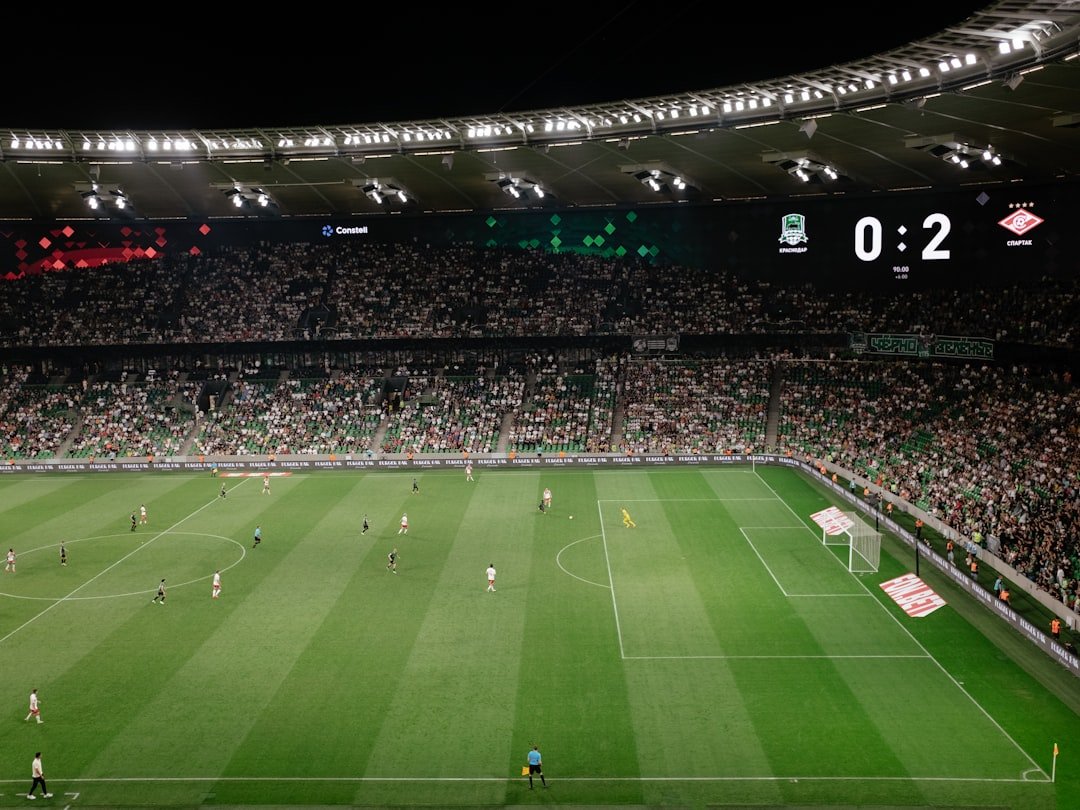
After every goal the VAR operators must complete a review within 3 minutes. The review checks for offside on the passer, fouls in the buildup, handball by the scorer, the ball going out before the goal, and any major defensive infraction missed.
The 3-minute process slows the rhythm of football. Many players celebrate a goal then have to wait for VAR to know if it counts. That waiting drains the spontaneous joy of a goal. The 2022 World Cup average review was 90 seconds, and FIFA has pledged to cut it to under 60 seconds for 2026.
VAR Review of Penalties

VAR has its biggest impact on penalties. Penalties are among football's most critical decisions, and traditional referees often misjudge due to viewing angle. VAR has lifted penalty-decision accuracy from around 75% with the referee alone to over 95% with VAR support.
This progress raised the number of penalties at the 2022 World Cup roughly 30% over 2018. Some fans say there are too many penalties, but in fact they are all rule-compliant, just missed before because referees could not see. VAR returns penalty decisions to the rule's intent, which is a good thing from that angle. But a reduction in match drama is also real.
Fewer Red Card Controversies

VAR's effect on red cards is also significant. Red cards at the 2018 World Cup were down about 40% from the 1990s, mainly because VAR makes referees more cautious. The 2022 World Cup brought a further drop.
But fewer red cards have downsides. Some serious fouls that should be red cards get downgraded to yellow or no foul after VAR review, and fans feel VAR has robbed referees of the courage to judge. This reflects VAR's double-edged nature. Technology makes decisions more accurate but also strips referees of subjective discretion.
The Human Cost of VAR

Each VAR operations team has about 15 people. The personnel cost per match is about 10,000 euros. A 64-match World Cup runs about 640,000 euros in VAR personnel, and with equipment maintenance, transmission, and training the total VAR investment per World Cup is around 5 million euros.
The cost is bearable for FIFA and top leagues but a huge burden for lower-tier leagues. The Bundesliga, Premier League, La Liga, Serie A, and Ligue 1 all have full VAR. The Chinese Super League, Portugal's Primeira, and the Eredivisie have simplified VAR. Most Southeast Asian, African, and South American leagues still lack VAR.
Controversy and the Future of VAR

The core controversy is whether VAR has changed football's nature. Football is a low-scoring game where each goal is scarce. VAR makes every goal subject to review, hurting the pure joy of the moment. Some traditional fans strongly oppose VAR and want a return to the pre-VAR era.
But FIFA and major leagues hold firm. FIFA argues fairness outweighs emotion, and VAR's accuracy gains are irreversible progress. VAR will be further upgraded for the 2026 World Cup, introducing AI offside prediction, automatic red-card detection, and live 3D match replays. Future VAR will become a full AI refereeing assistant, and traditional referees will look more like executors than decision-makers.
What Technology Has Cost Football

VAR has made football fairer, but it has also cost football something. Maradona's 1986 Hand of God would have been impossible in the VAR era. Hurst's likely offside goal at the 1966 final would have been canceled. Those iconic moments were preserved by their technological gaps. VAR ensures future controversies of that kind disappear.
But their cancellation also means fewer of football's human stories. Football is partly thrilling because of errors, regret, and accident. VAR's pursuit of absolute accuracy strips matches of emotional color. This is the central philosophical problem of football in the VAR era. Should technology serve sport or reshape it? FIFA has yet to give an answer.
📝 本文来自抖文 www.douwen.me ,转载请保留出处。
原文链接:https://douwen.me/archives/922/
💬 评论 (0)
还没有评论,来说两句吧 ✍️